Showing posts with label Art. Show all posts
Showing posts with label Art. Show all posts
11 December 2011
Arts Interview - Bridget Smyth
Another artsinterview piece with Bridget Smyth, Director of Design at the City of Sydney. The topic was Diversity. http://artsinterview.com/2011/11/28/arts-interview-bridget-smyth/


Two Highlights from the 12th Istanbul Biennial
 Nicolas Bacal, The Geometry of Space-Time After You, 2010
This work directly references Gonzalez-Torres’ iconic Untitled (Perfect Lovers) (1991) with two clocks in separate parts of the biennial and just a minute hand signifying the endless passing of time. The word ‘vos’ (Spanish for ‘you’) is repeated around the edges of the clocks’ faces. Bacal describes the work as “ridiculously romantic”; whether in its representation of love, frozen or eternal time, or simply the obsession with one person. The class presentation by Anna and Jess also examined this work from a similarly positive, quixotic perspective. What is worth considering, however, is the possibility of cynicism contained in this work. Gonzalez-Torres’ clocks were side-by-side, touching, but eventually fell out of sync as one ‘died away’ before the other, suggesting a physical end to their love. Bacal’s clocks are placed outside the white (and grey) cube, are separated, and do not show any passing of time, just an obsessive preoccupation with an ambiguous ‘vos’. Even though Bacal’s is hopelessly romantic, the love that is signified here perhaps never exists outside the boundaries of the clock faces. After all, they are not in sync, and the artist initially intended for numerous clocks to be displayed in disparate locations throughout the biennial, something that would undermine the ‘couple’ metaphor. Furthermore, the minute hands futilely run around in circles, chasing after the elusive ‘vos’, but sadly never finding each other. [Image from http://12b.iksv.org/en/sololar.asp?id=11&show=gorsel]
 Ahmet Ogut, Perfect Lovers, 2008
A work which wholly and beautifully captures the entire spirit and conceptual credo of the biennial is Perfect Lovers, another powerful appropriation of Gonzalez-Torres’ clocks. It presents a one Euro and two Turkish Lira coin (the same size), side-by-side and encased in a black velvet-lined vitrine. The work captures the desire to fuse minimalist aesthetics with political concerns, which here holds more substance than the combined worth of the coins, but is lighter, more poetic than their combined weight. This is a work which is grounded in the political and completely dependent on an imbalanced and constantly shifting geo-political context for its continually-renewed interpretation. Created in 2008, the two coins are, of course, never ‘perfect lovers’. Instead, the fluctuating struggles within their turbulent relationship are entirely dependent on the oscillating power relations between the European Union and Turkey. Ironically, this kind of tempestuous chemistry could make them the perfect lovers, depending on the audience’s understanding of love and relationships. The endless interpretative possibilities, along with the layers of meaning encased within this small vitrine, between these two unassuming coins, make this artwork the most powerful and effective in the 12th Istanbul Biennial. [Image from http://www.ahmetogut.com/ahmetwebperfect.html]
Untitled (12th Istanbul Biennial)
The 12th Istanbul Biennial is a quiet and contained exhibition which rejects the seduction of the spectacle characteristic of most biennials. In line with its institutional departure, the show’s grounding in the work and practice of artist Felix Gonzalez-Torres establishes a solid and unique conceptual framework. Untitled (12th Istanbul Biennial) is divided into five sections, each also ‘Untitled’ followed by a description in parentheses. This emulates Gonzalez-Torres’ naming practices in order to instil a sense of timelessness and never-ending possibilities for meaning-making. The underpinning premise of the biennial is to invest life and politics into a minimalist aesthetic in the spirit of Gonzlaez-Torres’ understated creations; deceptively sparse, yet teeming with political potency. Curators Jens Hoffman and Adriano Pedrosa have revived this method of art making in a concentrated and tightly-curated exhibition thematically linked to specific works of Gonzalez-Torres’.
Untitled (Abstraction) contains works which complicate the sterile environments of Minimalism and the Modernist grid with elements of the social, political, personal, historical and, quite simply, the everyday. The works in this section appear to unravel abstraction, inject it with subjectivity, and then reconstitute it as a strange and provocative hybrid. Works such as Geta Bratescu’s Vistigli from 1978 and Lygia Clark’s Bicho sculptures from the 1960s retrace a history of art which effectively infused elements of the everyday into essentially abstract forms, thus blurring the divisions between the two.
Themes of love, loss, homosexuality and the AIDS epidemic are explored in Untitled (Ross), the section named after Gonzalez-Torres’ candy spill work. This section abounds with quite literal and anthropomorphic interpretations of gay love, along with works which directly reference Gonzalez-Torres’ presentations of this idea, including Kutlug Ataman’s Forever. However, there are also some noteworthy pieces, including ceramics from the Ardmour Ceramic Studio in rural South Africa which depart from the more self-indulgent pieces. Made by locals, these depict didactic narratives, presented in a series of confronting literal and symbolic images, to educate locals about HIV and AIDS awareness.
Untitled (Passport) envisages new ways of looking at the world and understanding its physical, political and psychological boarders. Works such as Ataman’s Su and Kirsten Pieroth’s Weltkarte (Map of the World) completely subvert the imagined boarders of identity and political geography in order to reinterpret these constructs. Meanwhile, solo presentations like Simon Evans’ deal with the quest (and inability) to locate identity within an increasingly globalised and disjointed world through playful panderings to obsessive idiosyncrasies.
The writing, rewriting and non-writing of history are played out in Untitled (History) which explores the tasks of recording, censoring and interpreting the past. This section presents contemporary artists who reflect on history and its constructions. Works like Julieta Aranda’s plexiglass cube containing pulverised 20th century history books, as well as Claire Fontaine’s replacement of Guy Debord’s The Society of the Spectacle with a brick are anarchic acts which undermine Western practices of empirical recording of knowledge and events. Furthermore, Taysir Batniji’s Suspended Time is a metonymic freezing of history by presenting an hourglass on its side – static and unchanged.
Finally, Untitled (Death by Gun) concludes the biennial on a sombre and disconcerting note. Many of the works in this section were made before Gonzalez-Torres’ time, and thus trace a timeline of gun violence and its portrayal through visual media as far back as the American Civil War. The proliferation of gun violence and the social apathy which now accompanies it is reflected through the plethora of gory, gruesome and graphic images. The fact that much of the audience are merely ‘unsettled’ by these images attests to our engrained societal desensitisation, and hence inaction, to such violent subject matter. It is a fitting conclusion to an overall thoughtful, stirring and dramatically understated exhibition.
In a rapidly expanding art world that is being invaded by biennials, art fairs and overblown international events, it is easy to lose (or never even gain) the thrill of an exhibition in the attitude of ‘yet another biennial’. Untitled (12th Istanbul Biennial) has snapped art world inhabitants out of their biennial sugar coma with a heavy dose of thoughtful, unassuming and compelling contemporary art. Its grounding in the works and philosophies of Felix Gonzalez-Torres offers a fresh and effective way of conceptualising biennials. It steps away from the acutely political, and embraces the artist’s whimsical spirit, injecting the biennial model with what Pedrosa calls, “a sort of poetic angle that maybe enchants and enlightens you, maybe makes you think differently about the world.” This ambition has been achieved with integrity and humility in what many are referring to as an ‘intellectual biennial’; an exhibition which effectively stimulates the interaction between abstraction and politics, formalism and subjectivity, high art and the everyday. Above that, the exhibition has reintroduced an important artist and a provocative, and enduring, concept of art making to a new generation, a new century, of arts practitioners. That is the gift of Untitled (12th Istanbul Biennial).
There are way too many artworks for me to share all the images. So check out the Biennial website for artwork images http://12b.iksv.org/en/sololar.asp
Untitled (Abstraction) contains works which complicate the sterile environments of Minimalism and the Modernist grid with elements of the social, political, personal, historical and, quite simply, the everyday. The works in this section appear to unravel abstraction, inject it with subjectivity, and then reconstitute it as a strange and provocative hybrid. Works such as Geta Bratescu’s Vistigli from 1978 and Lygia Clark’s Bicho sculptures from the 1960s retrace a history of art which effectively infused elements of the everyday into essentially abstract forms, thus blurring the divisions between the two.
Themes of love, loss, homosexuality and the AIDS epidemic are explored in Untitled (Ross), the section named after Gonzalez-Torres’ candy spill work. This section abounds with quite literal and anthropomorphic interpretations of gay love, along with works which directly reference Gonzalez-Torres’ presentations of this idea, including Kutlug Ataman’s Forever. However, there are also some noteworthy pieces, including ceramics from the Ardmour Ceramic Studio in rural South Africa which depart from the more self-indulgent pieces. Made by locals, these depict didactic narratives, presented in a series of confronting literal and symbolic images, to educate locals about HIV and AIDS awareness.
Untitled (Passport) envisages new ways of looking at the world and understanding its physical, political and psychological boarders. Works such as Ataman’s Su and Kirsten Pieroth’s Weltkarte (Map of the World) completely subvert the imagined boarders of identity and political geography in order to reinterpret these constructs. Meanwhile, solo presentations like Simon Evans’ deal with the quest (and inability) to locate identity within an increasingly globalised and disjointed world through playful panderings to obsessive idiosyncrasies.
The writing, rewriting and non-writing of history are played out in Untitled (History) which explores the tasks of recording, censoring and interpreting the past. This section presents contemporary artists who reflect on history and its constructions. Works like Julieta Aranda’s plexiglass cube containing pulverised 20th century history books, as well as Claire Fontaine’s replacement of Guy Debord’s The Society of the Spectacle with a brick are anarchic acts which undermine Western practices of empirical recording of knowledge and events. Furthermore, Taysir Batniji’s Suspended Time is a metonymic freezing of history by presenting an hourglass on its side – static and unchanged.
Finally, Untitled (Death by Gun) concludes the biennial on a sombre and disconcerting note. Many of the works in this section were made before Gonzalez-Torres’ time, and thus trace a timeline of gun violence and its portrayal through visual media as far back as the American Civil War. The proliferation of gun violence and the social apathy which now accompanies it is reflected through the plethora of gory, gruesome and graphic images. The fact that much of the audience are merely ‘unsettled’ by these images attests to our engrained societal desensitisation, and hence inaction, to such violent subject matter. It is a fitting conclusion to an overall thoughtful, stirring and dramatically understated exhibition.
In a rapidly expanding art world that is being invaded by biennials, art fairs and overblown international events, it is easy to lose (or never even gain) the thrill of an exhibition in the attitude of ‘yet another biennial’. Untitled (12th Istanbul Biennial) has snapped art world inhabitants out of their biennial sugar coma with a heavy dose of thoughtful, unassuming and compelling contemporary art. Its grounding in the works and philosophies of Felix Gonzalez-Torres offers a fresh and effective way of conceptualising biennials. It steps away from the acutely political, and embraces the artist’s whimsical spirit, injecting the biennial model with what Pedrosa calls, “a sort of poetic angle that maybe enchants and enlightens you, maybe makes you think differently about the world.” This ambition has been achieved with integrity and humility in what many are referring to as an ‘intellectual biennial’; an exhibition which effectively stimulates the interaction between abstraction and politics, formalism and subjectivity, high art and the everyday. Above that, the exhibition has reintroduced an important artist and a provocative, and enduring, concept of art making to a new generation, a new century, of arts practitioners. That is the gift of Untitled (12th Istanbul Biennial).
There are way too many artworks for me to share all the images. So check out the Biennial website for artwork images http://12b.iksv.org/en/sololar.asp
12 September 2011
Arts Interview - Nicky McWilliam
An interview I did for Arts Interview with Nicky McWilliam, director of Eva Breuer Art Dealer. The topic was Stress and Wellbeing, something that many arts workers are familiar with.
http://artsinterview.com/2011/09/05/arts-interview-nicky-mcwilliam/
http://artsinterview.com/2011/09/05/arts-interview-nicky-mcwilliam/
30 August 2011
John Kaldor Family Collection, AGNSW
 This one is more of a reflection than a review, because while the works are spectacular, there are more interesting forces at play behind the scenes that I would like to explore.
The AGNSW’s shiny new 3000 square metre marble basement level has, as its inaugural exhibition, a vast display of works from John Kaldor’s donated collection. Worth a cool $35 million, the works are exhibited in the new contemporary gallery baring the Kaldor family name.
The exhibit is indeed impressive, including works from many of the most important art movements of the late twentieth century and the new millennium. Kaldor is one of the world’s foremost collectors of Sol LeWitt’s works, and the artist is generously represented in the gallery – note the LeWitt row. Along with LeWitt, his Conceptualist counterparts adorn the walls and floor of the gallery, including Carl Andre, Frank Stella, Donald Judd, and Bernd and Hilla Becher. Pop Art icons Jeff Koons and Robert Rauschenberg are present, as are video and photographic big-names like Gilbert & George, Andreas Gursky, Nam June Paik, Bill Viola, and Australia’s golden boy of the moment, Shawn Gladwell. Of course, Christo’s wrapped gems are also on display. Unsurprisingly, artists who have been brought out (or will be shortly) through Kaldor Public Art Projects are also represented, including Barry McGee, Urs Fischer, Ugo Rondinone and Michael Landy.
Along with the works from his private collection, Kaldor had also commissioned three new works by artists already in the collection; Rondinone, Richard Long and a very cool reproduction of a room in the collector’s own home created by those from LeWitt’s studio.
Something of note however; the very generous donation of this collection cost the gallery (ie. NSW government) about $30 million in itself – money spent to refurbish the basement floor, which was originally the storage room, and hence moving storage of artworks off site. While I am obviously a fan of government spending on the arts (I know which hand it is that will most likely feed me), it is interesting that Kaldor has found a cheeky loop-hole that many of his wealthy collector peers from around the world have not discovered (or at the very least, not pursued). Usually, when an art collector has a substantial amount of works in his (yes, mainly his) possession, he will most likely fork out his own money to build a fancy facility to match the fancy art that it will show – Charles Saatchi and Francois Pinault (whose museum ostentatiously sits almost adjacent to Venice’s Biennale venues) are notable examples, as is Australia’s own eccentric iconoclast David Walsh with the opening of MONA at the beginning of this year. This way, the collector gets to share his work with the public, and also bask in the glory of his collection, which is first and foremost a portrait of him as a collector, and by extension a person, and only secondly a presentation of whatever eras of art from which he has collected. And of course, the running and maintenance of these private galleries has ongoing costs, for the life of the venue – Walsh’s, for instance, will cost about $10 million per year to run. So it seems then, by comparison, that Kaldor may have side-stepped a costly project through the relatively small donation of $35 million worth of art; the AGNSW and NSW government carry the costs of building the venue, and of course the costs of maintaining it and staff in perpetuity, while Kaldor gets to share his collection with the world and have his name on the gallery wall anyway. It’s a win-win for the business-savvy art lover.
Last, but certainly not least: going back to my point about any private collection being primarily a portrait of its collector. Notice the names that are listed here: there is one woman, who appears in partnership with her husband. In fact, out of the vast collection of works donated by Kaldor, 194 are by male artists, six works are collaborations, and two works are by female artists. These statistics prove a far cry from claims of this being the most ‘comprehensive’ collection of contemporary art, as Mr Capon would have you believe in various pieces of press. It has occurred to me that there is a perfectly reasonable explanation for this – Kaldor simply chose to keep the works made by women and donate the men’s ones. But I doubt it. So beware when you go to see this admittedly impressive display of works – there are women Conceptual, video, photographic, Pop, etc, etc, etc, artists, even if Mr Kaldor did not deem it necessary to collect them equally. [Image (C) 2011 Alan Miller]
08 June 2011
Ken + Julia Yonetani - Still Life: The Food Bowl
 Ken and Julia Yonetani’s latest exhibition, ‘Still life: the food bowl’ is just as exquisite and ecologically pressing as their previous works. The result of a nine month residency in Mildura, the sculptures in this exhibition are made entirely of salt from the Murray River. The exhibition comprises of three Greco-Romanesque plinths (made of salt) on which small salt sculptures of fruit, vegies and lobster rest; a large table displaying a salt-sculpted feast of much of the same produce, five empty frames which represent the five senses, and a large salt and metal chandelier suspended just inside the front display window. Currently showing at the Artereal in Rozelle, the website describes the exhibition as such:
Along the Murray-Darling basin, known as Australia's 'food bowl' because it produces up to ninety per cent of Australia's fresh food, 550,000 tonnes of salt is pumped out of the ground every year to try and stem the increasing rise of highly saline ground-water.
Still Life: The Food Bowl is made from this groundwater salt. It draws on the still life genre as an artistic tradition that emerged as current agricultural practices were being developed, bringing new food produe to the tables of a rising European bourgeois class. (http://www.artereal.com.au)
Much like the sugar of Yonetani’s monumental ‘Barrier reef’, here the salt is a metaphor for the excess and gluttony that has come to characterise human consumption throughout history, through to the present day. As Artereal’s website states, salt acts as ‘a powerful, sacred substance that maintains life by enabling food preservation, but also induces the death of ecosystems and the collapse of empires.’ Indeed, the way in which the salt sets to become sculptures, hard like stone, is demonstrative of what happens to an environment largely neglected and sacrificed to fulfil the wants of human desire. It was this environment that the Yonetanis witnessed first-hand at Mildura, and it is the one they now urge us to consider.
Within the installation is a dialectic of abundance and scarcity indicative of the human condition. While there is a lavish array of food, moulded from the produce of the ‘food bowl’, it is unmalleable and bland – lacking colour, material variety, and flavour. The empty frames which adorn the gallery walls – adjacent to the still life which sits virtually still, solid on a table in the middle – emphasizes the ironic beauty of this installation. The frames contain nothing, but are supposed to represent the five senses, while the subject matter of still life sits before them, drained of their visual vibrancy, uncontained within the frames and unable to stimulate the senses. The imposing chandelier, illuminated by both artificial and natural light, intricately composed yet hollow in the middle, reinforces this tension and accentuates the theme of excess.
The exhibition is brilliant, permeated by the quiet, reflective message that has come to characterise the Yonetanis’ works; eerie in its silence, yet persistent in its call to action. It is on show until 2 July. [Image from http://arterealgalleryblog.blogspot.com]
Global warming CAN be over: the art of Ken Yonetani
This is an essay I wrote for a university magazine last year. It gives context about environmental art in general, as well as Yonetani's work and is the prequel to what I am posting about his current exhibtion, 'Still Life'. It is long (you've been warned)
As much of the art industry thrives on the neo-liberalist spirit of consumerism, making luxury goods of art; many artists also crusade for social, political or environmental causes. Ken Yonetani is one of the latter. While many of his ephemeral works escape the commercial quality of being sold, they are poignant and powerful vehicles for raising awareness of some of the ecological, and hence social, problems which plague our modern world. Yonetani is part of a growing breed of artists who are ‘Getting to grips with the idea of ecological systems as art...as the substance of art practice itself.’ (Editorial, 2005, p.14) But the tireless efforts of artists like Yonetani, who so passionately create works in the hope of informing and educating audiences, beg a very important question: Can art really affect change?
An increasingly unnatural world.
In a disturbingly prophetic essay titled ‘Art and Ecological Consciousness’, first published in 1970, Gyorgy Kepes warned that:
Disregard for nature’s richness leads to the destruction of living forms and eventually to the degradation and destruction of man himself...we are all carried along by the uncontrolled dynamics of our situation and continue to develop ever more powerful tools without a code of values to guide us in their use. (Kepes, 1972, p.2)
Indeed, since the dawn of industrialisation, the natural environment has always been a faint afterthought in the pursuit of technological greatness that boosts both profits and mankind’s insatiable need to tame and control nature. And while Kepes recounts fleeting moments of poetic caution over the centuries – more than a hundred years ago, John Ruskin proclaimed, ‘Ah, masters of modern science...you have divided the elements, and united them; enslaved them upon the earth and discerned them in the stars.’ (Kepes, 1972, p.1) – the narrowly-focused task of advancement at any cost has proceeded relatively unobstructed. It is only in the final decades of the twentieth century that the environmental consequences of a hitherto uncapped project of technological progression have been acknowledged by citizens that form the privileged minority. We came to realise, as Kepes so eloquently reflected, that ‘Shaped with the blighted spirit of cornered man, our cities are our collective self-portraits, images of our own hollowness and chaos.’ (Kepes, 1972, pp.3-4) And though it may not be too late, much of the damage is certainly irrevocable, causing great anxiety and uncertainty for the future.
At the same time, art’s relationship with nature became precarious as industrialisation gained more steam, and ecological apathy became the norm. Both, as Felicity Fenner writes, drifted apart and ‘each suffered at the hands of social and political indifference.’ (Fenner, 2007, p.422) While artistic expressions of nature and the natural order still existed, such forays were intermittent and became more sporadic as humanity and nature became more disparate. ‘While oblique reference to the natural world is found in geometric abstraction of the modernist era,’ Fenner claims, ‘it wasn’t until the 1960s, when a renewed socio-political interest in the environment inspired a young generation of revolutionary artists, that nature again became valid subject matter in contemporary art.’ (Fenner, 2007, p.422) Land art, and works addressing ecological issues came to the fore as artists began to register society’s discomfort with their increasingly concrete and artificial surroundings. Pioneering artists such as Richard Long, Dennis Oppenheim, and iconic, ground-breaking (literally) works such as Robert Smithson’s Spiral Jetty brought art and artists back to nature, albeit a permanently altered nature. Now at the dawn of the 21st century, the need to preserve the natural world has become an imperative, and artists are at the forefront of a movement that seeks more accountability from humans for their ecological footprint.
While they were once polarities, art and science are now, more than ever, joining forces for a greater cause. Given the increasingly destabilized state of today’s natural environment, artists and scientists are collaborating to raise awareness of the issues and to offer solutions. In the last decade, international art collectives such as Ecoarttech, super/collider and Cape Farewell, have emerged to fuse the pragmatism of science with the creative processes of art to, as Cape Farewell’s mission states, ‘stimulate the production of art founded in scientific research.’ (Cape Farewell, n.d.) Such developments highlight the recognition of the universal need to make concerted efforts towards ecological revival and sustainability. The partnership between art and science therefore represents the holistic actions that need to be taken; art to present the environmental damage caused by human activity and to further re-imagine a better, more ecologically-viable world, and science to impress upon us the disastrous consequences of not striving to attain this world. Simon Torok, CSIRO scientist and Artlink contributor, offers an uplifting and hopeful illustration of how collaboration can affect change: ‘Together, art and science can inspire an emotional response, inspiring changes in our attitudes and behaviour that ensure our landscapes survive in more than photographs, paintings and memories.’ (Torok, 2005, p.17)
An artist on a quiet mission.
Ken Yonetani started his working life in one career and has ended up at the other end of the spectrum. Originally a finance broker in Tokyo, he was immersed in the narrow, pragmatic, ecologically disinterested world of profit and economics. After three years Yonetani quit his job and spent several more years searching for his calling, which he found in art, as an apprentice to the master potter Kinjo Toshio in Okinawa. From there, a natural progression to conceptual and environmentally-focused art occurred, as the artist recounts:
I am from the concrete jungle of Tokyo. I felt an urge to draw on my own experiences, and from this moved into the realm of conceptual art. For me environmental loss caused a sense of anxiety: working with my hands, I was able to regain a sense of calm. It was only natural to link the calming action of art-making back to something with an environmental message. (Yonetani, 2005, p.33)
A large part of his environmental message is to bring to light the destructive desire of humanity. Yonetani believes it is important for people to ‘see and feel actual works rather than virtual things.’ Many of his artworks, especially the earlier ones such as the fumie tiles, physically recreate this propensity for destruction. These tiles were destroyed shortly after their unveiling on both occasions of their showing at the CSIRO’s Discovery Centre in 2003 and the Asian Traffic project at Gallery 4A in 2004. In both instances, the tiles, which contained models of endangered Australian butterflies that Yonetani himself had individually handcrafted, were placed at the entrance of the exhibition and crushed under the feet of opening night guests, effectively destroying months’ of work with disturbing voracity. Julia Humphrey offers a detailed recollection of how the installation unfolded at the CSIRO exhibition, drawing parallels between the human condition and the act of destroying another person’s work:
Some people...stepped across the tiles below with a sense of dread. Others stomped across the breaking floor with a kind of pained glee...titillating and yet excruciating... desperately trying to save some of the tiles...Several children also picked up some unbroken tiles, only to place them down once again and smash them with a loud and forceful stomp. After they had been smashed, the children then carefully began trying to place the pieces back together again...Several people began putting tiles into their handbag or under their arms, laying claim to them with a sense of triumphant defiance. Yonetani smiled. This too was another display of human desire – the desire to possess and stake a claim of one’s own. (Humphrey, 2004, p.23)
The reactions and emotions by visitors are a telling portrayal of the human desire to both inflict wanton destruction on their surroundings, and then realise the futility of trying to recreate such a fragile environment. ‘I cried a lot with those ephemeral works,’ Yonetani recalls, perhaps lamenting not only the destruction of his hard work, but what such destruction reflects about the human condition. Many of these broken fumie tiles were subsequently put together to create a new installation of a butterfly mandala. The butterfly pictures of this new work, Yonetani explains, ‘form the ghosts of the destroyed tiles, sacrificed by human’s impact on nature, and a gateway to the spiritual world.’(Yonetani, Westspace, 2005)
Sweet barrier reef, Yonetani’s most celebrated work, is a quiet, subtle comment on the state of ocean floor habitats. In its monumental scarcity, the large sculptural installation, modelled after a Zen garden form and made entirely of sugar, represents the coral wastelands that much of our oceans’ underwater ecosystems have become. The sugar is at once metaphorical and literal; it directly points to the sugar industry’s chemical run-offs as the primary cause for the bleached coral, and also stands as a metaphor for the Western world’s increasing gastric gluttony and desire, manifested through excessive consumption, at any (environmental) cost. At the opening night of Once Removed, the group exhibition in which this work represented Australia at the 2009 Venice Biennale, models in coral-inspired bridal dresses meandered through the throngs of guests, holding delectable, intricately designed wedding cakes, sculpted by the artist. The bright colours of these dessert sculptures were a stark contrast to the deathly white of the installation they accompanied. The performance, entitled Sweet barrier reef for the 21st century – play Strauss’s waltz grandly, included a choreographed dance followed by the models serving up the cakes to guests, creating a relational space which facilitated an interaction and dialogue between artwork and audience. In this case, as well as indulging in one of life’s great culinary pleasures – a wedding cake! – the audience became complicit in the physical destruction of Yonetani’s exquisite sugary sculptures, but metaphorically too in the destruction of the ecosystem that these sculptures represented.
Yonetani’s most vocal, assertive and political attempt to create environmental awareness in the general population is a performance piece he delivered in collaboration with his wife, Julia Yonetani. Global Warming is Over! (if you want it) was a bed-in staged in the middle of Melbourne’s Federation Square on a hot, 35ish°, February weekend in 2010. Emulating John and Yoko’s famous 1969 Amsterdam ‘War is Over!’ bed-in, the performance, which received Yoko Ono’s blessing, was staged to draw attention to climate change and the need for action. ‘The message is the same as the message that John and Yoko had’, Julia explains, ‘if you want something you can actually make it happen...Both of them (war and global warming) we should be able to stop by human action, because they’re caused by human action.’ (J. Yonetani quoted in Pardi, 2010, pp.31-32) The public element of their performance, in which the couple stayed in their Fed Square bed all weekend in John and Yoko wigs, also helped the Yonetanis to take their work and message to a wider audience. ‘People we had chats with in our performance are quite ordinary and do not go to gallery openings often’, Yonetani explains. ‘We discussed about global warming with various opinions. It was very interesting to talk with different people.’ Furthermore, the performance can be considered a direct call to action, informing the public that global warming can be over, if they want it, if they are willing to work for it. The sweltering heat only served to re-enforce the urgency of the message.
Given the conceptual strength of Yonetani’s artistic practice, and the social importance of its message, the artist does not fall into the trappings of ‘crusader’. Rather, his works act as quiet, reflective protests; they impress upon the audience the necessity for change, yet leave the onus for action on the individual. In fact, the only violence in Yonetani’s practice is that which is inflicted on his intensely-laboured creations.
The artist’s next step will be an intense foray into interdisciplinary practices, as the Yonetanis begin their three-month artist residency in Mildura, on the border of the Murray River in Victoria. Long established as a hub for experimental projects where art and science join forces in the quest for ecological revival, Mildura seems the perfect place for Yonetani to begin his next artistic journey. Here, the couple will be collaborating with local scientists to explore the nature of salt, water and salinity as such issues are pertinent to this dry continent, and important to the artist. No doubt what the Yonetanis create will be a telling reflection on humanity’s (mis)use of that most precious of resources – water.
Is art enough...?
In 1972 Kepes introduced the notion of consigning the artist to the task of creating an ecological consciousness. Kepes expounds on ‘the role of the artist in educating the public to understand our ecological situation, and how he can serve to renew the sense of happy equilibrium between man and his environment.’ (Kepes, 1972, p.170) While many artists like Yonetani have enthusiastically stepped into this role, one wonders if art really is enough to change the world. What is the real, practical reach that artists can have on a largely uninterested first world which continues to burn through natural resources faster than they can be replenished? What’s more, should it be the social expectation, or burden even, of artists to take on such a monumental task as changing the mindset and careless living patterns of a population based on rampant consumerism and immediate self-gratification? In other words, is it really the responsibility of artists to change the world? While one’s immediate response would be a resounding ‘No!’ when asked this very question, Yonetani humbly, yet resolutely, replies, ‘I think it is not only given to the artists. All the people have a responsibility to try to change the world.’ From here, it appears that there’s nothing left to say, only do.
List of references
Fenner, F., ‘The nature of art’ in Art and Australia, v. 44, no. 3, Autumn 2007, pp.420-27
Humphrey, J., ‘Ken Yonetani’s Fumie tiles – the art of destruction’ in Ceramics: Art and Perception, no.57, 2004, pp.21-23
Kepes, G., ‘The artist’s role in environmental self-regulation’ in Arts of the Environment, G. Kepes [ed.], New York: George Braziller, 1972, pp.1-12
Kepes, G., ‘Art and ecological consciousness’ in Arts of the Environment, G. Kepes [ed.], New York: George Braziller, 1972, pp.167-197
Pardi, L., ‘GLOBAL WARMING IS OVER! (If you want it)’ in Beat Magazine, Wed 17 Feb 2010, pp.31-32
Torok, S., ‘Picturing climate change’ in Artlink, v.25, no.4, 2005, pp.16-17
Yonetani, J., ‘Sweet revenge: interview with Ken Yonetani’ in Artlink, v.25, no.4, 2005, pp.32-35
Yonetani, K., ‘Exhibition invite text’ at Westspace Gallery, 27 May – 11 June 2005, [Accessed 1 Sept. 2010] http://www.westspace.org.au/program/ken-yonetani.html
Yonetani, K., 2010, email 10 Sept., < ken@kenyonetani.com>
‘Editorial’ in Artlink, v.25, no.4, 2005, p.14
‘About Cape Farewell’ n.d. in Cape Farewell, [Accessed 3 Sept. 2010] www.capefarewell.com/about.html


[Images from http://kenyonetani.com]
07 February 2011
Through Young Eyes - Jacquelyn Ngo
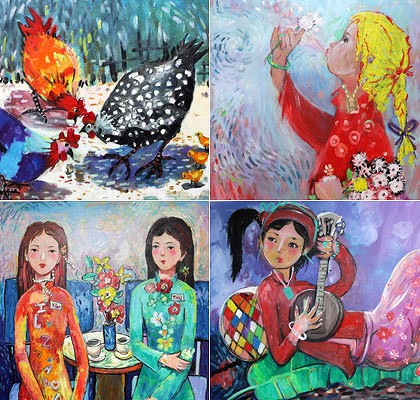
Once you get over the initial shock of Jacquelyn’s age, and that intimidating feeling of deep inadequacy makes its way back into the dark crevices of your mind, you can then begin to immerse yourself in the energy and vibrancy of these magnificent canvases. Hung in succession along the two walls of a narrow hallway on the old Powerhouse’s second floor, the van Gogh-esque works reveal the unhindered imaginative world of a carefree and vivacious child who, beyond painting what she sees, paints the way in which she sees her surroundings. By the end of my journey down the short corridor I was almost in tears by the honesty and unabashed sincerity of the paintings. The innocence, pure creativity and lack of agenda of this body of work is not only refreshing, but also allows one to experience the genuine joy of looking and being immersed in Jacquelyn’s enchanting world.
 Her subjects are the everyday people and places which inhabit her life; friends, school, her apartment block, the beach, her family, herself. Yet they are bathed in a delightful pallet of intense colour and bold brushstrokes; never in any ‘realistically-painted’ setting, but rather in an imagined swirl of colours, and light, and koalas sitting on a Christmas-trees-filled beach. In a nostalgically familiar self-portrait, Jacquelyn lies daydreaming on a grassy hill, against a sky of pink and purple hues, while her Maths homework lies, neglected, by her side.
But more than being an indulgent and overblown colouring book, Jacquelyn’s body of work also express how the young artist is proud of her hybrid heritage. Many of the paintings reveal a beautifully innocent and organic fusion of Vietnamese and Australian culture. In ‘Flowering’, Jacquelyn and her mother are wearing the traditional Vietnamese ao dai as they stand in a garden which contains an Australian flag on a pole, the iconic Australian sun, and a koala in a tree.
This exhibition is heart-warming and promising in so many ways, and the Casula Powerhouse must be commended for giving such credibility and regard to the work of a young artist from the area. Jacquelyn’s paintings are not solely the product of a young girl with skills and perceptions exceeding her years. Beyond that, they represent the wealth of unfounded talent that exists in all sections of society, and which can be discovered when the surfaces of the unlikeliest of places are scratched. [Images from http://www.smh.com.au/]
14 January 2011
Annie Leibovitz: A Photographer's Life 1990 - 2005

The list of celebrities photographed reads like the guest list for Oscars night. Johnny Depp and Kate Moss in a lazy embrace on a hotel bed; Brad Pitt engulfed by a backdrop and questionable wardrobe of warm hues; Nicole Kidman, polished and regal, amongst the spotlights of a concert hall; THAT photograph of Demi Moore, and next to it, a lesser known one of the bare-breasted actress with then-husband Bruce Willis’ lovingly-protective hands secured around her pregnant belly. The rapport and comfort between the photographer and her celebrity subjects is apparent, with many of the photographs capturing that essence of humanness that is often lost in the two-dimensionality of the celebrity world and the multitudes of images that capture this world. Leibovitz’s photographs show us that these are merely people, with their own complexities and intricacies, which only her lens can capture. Most haunting, but beautiful, is a monochromatic photograph of a lone Mic Jagger, sitting on a simple white bed, looking forlorn yet stoic. Here, the legendary rock star is just a man, no different to the men of Leibovitz’s family, whose photographs line the same walls as that of the celebrities.
Indeed, amongst the famous faces are those of Leibovitz’s family, in black and white photographs that chronicle the everyday-ness of their lives; at the beach, in the kitchen, in bed, the backyard. Author and literary theorist Susan Sontag is also heavily represented, as the exhibition includes photographs of Leibovitz’s ailing friend. Sontag’s fatal experience with cancer is recorded in detail; from her promising, yet frail, recovery, to her unfortunate relapse and deterioration, and finally to her final moments on an ambulance stretcher, Leibovitz shows her dedication to her friend as she is there every step of the way, capturing the moments that are dear to them both.
My favourite photograph in the exhibition is of dancer Bill T. Jones at Sun Studios in 1993. Here, Leibovitz shows why she is the master of the monochrome in a beautifully double-framed image of the back of the naked dancer in a delicate mid-jump. His dark skin is a crisp contrast to the backdrop of the white studio wall, which in turn is backgrounded by the grounds and buildings of a dilapidated industrial site. So many elements of dance, grace, texture, colour and contradictions are at work in this stunning, liberating, almost cathartic image.
The exhibition ends with two walls of chronologically-ordered prints, one personal, the other professional, which have been transplanted from Leibovitz’s home studio. Containing everyone from the Obamas and the Clintons (who appear on the ‘personal’ wall), to the photographer’s three young daughters, these walls are a fitting conclusion to the immensity and overwhelming density of the body of work one has just journeyed through (I didn’t even get to mention the large-scale landscape photographs which dwarf the very room they hang in). They capture the spirit, professionalism, longevity, and innovativeness of Leibovitz’s still-strong career. And with the birth of the photographer’s first child in 2001, the death of her dear friend Susan Sontag in 2004, and the arrival of her twins in 2005, this exhibition perhaps marks the end of one stellar phase of her life and the beginning of a new, but no less epic, journey. I am anticipating the photographic results of that in another 15 years. [Image from http://www.dailygloss.com/]
26 November 2010
Rehearsal - Shanghai Biennale

At the core of the ‘Rehearsal’ biennale is the Ho Chi Minh Trail, brought to us by the organisers of the Long March Project, which will sustain the show, along with other separate projects, throughout its four acts. Works from this project are dotted throughout the levels of the Art Museum, but, due to questionable curatorial organisation, were either dwarfed by other works or simply mixed in with unrelated pieces which made them hard to identify, and hence appreciate, as being from the Ho Chi Minh Trail. Particularly on the first floor, where an amalgam of paintings, photographic prints and videos were meshed in with other disparate works, the effect was nothing more than a curatorial mess. This was definitely the part where the ‘rehearsal’ needed a whole lot more tweaking before the final production.
Individually, there were works of impeccable quality and solid concepts. Chinese artist Liu Xiadong’s pair of large-scale paintings depicting the at once hopeless and hopeful aftermath of the Sichuan earthquake are such works. ‘Getting out of Beichuan’ portrays a group of teenage boys in a small boat, seemingly floating directionless, yet peacefully, amidst a flock of white cranes in mid-take off. Adjacent to this is ‘Entering Lake Tai.’ Equally grand in scale, this painting presents a group of young girls poised stoically in the place where their lake once was, against the backdrop of a mountain village in rubbles. Accompanying these pieces are documentary photographs and videos of the artist in the arduous process of painting. This is one example of where the ‘Rehearsal’ theme was perfectly executed.
Of course, not all were as polished or conceptually sound. One ‘installation’ (if you can call hanging up some pieces of paper on a three-walled room an installation, which the organisers of the show did) which prompted a loud “WTF!” and quite a bit of disappointment and resentment from yours truly was Austrian artist Josef Trattner’s wine paintings. Yeah, that’s right, wine. And it was called ‘Blind Taste’. Something was definitely blind in not only the creation, but selection of this work for the biennale. This installation was found in what I came to realise was the Nepotism Corner; a section of the top floor predominated by works which did not appear to fit the theme or any concept of good art, and were probably there through some personal connection with the curators (on the gossip side of the art world, the Shanghai Biennale is apparently notorious for sneaking in friends of those in high places). Trattner’s wine paintings has to be one of them, otherwise the only other explanation for its inclusion in the show is that someone was really drunk (and blind) when the decision was made. While wine can work as a meaningful symbol of civilisation, this was no way to metaphorise it. The works, quite literally a mass of A2 sized paper covered in splotches of either red or white wine and sprinkled with glitter, are supposed to, according to the guidebook, “bring back your deepest memory, arouse the most passionate emotions, and remind you of the mightiness of history.” WTF?!?! By this time, I had major biennale fatigue, having already been through two biennales in five days and I had no patience for such rhetorical fluff and bad art.
Another phenomenon I discovered here was wall text composed in what I can only describe as the strange literary style of socialist rhetoric. This is not necessarily a good or bad thing, just an anomaly amongst all other captions I have read. Whether it be a language/translation barrier, or a real indoctrination of socialist expression that has made its way into the biennale world, the texts seemed to speak directly to the reader, and offer strong suggestions on what we should think and feel about the works. The above quote is one example amongst many that caught me off guard and left me feeling like I had just been told how to think, but in the nicest of ways.
So that is the spectrum of the quality of works in this very convoluted show. After over a week of reflection, I’m still not sure of what I think of it. While a biennale should not be judged purely for the way in which it interprets and implements its own theme (as many of these are arbitrary and deliberately broad, chosen in order to include almost anything in the show), I feel as though Shanghai, in particular, did not execute its theme adequately at all. That said, many of the works were beautiful, stunning, thought-provoking, moving and just plain good in their own right, and perhaps that’s what I should take from the experience of the Shanghai Biennale. Simply that it was a show with a real mixture of good and bad art. [Image from http://www.supernice.eu/]
19 November 2010
Living in Evolution - Busan Biennale, South Korea

The theme of the Busan Biennale is ‘Living in Evolution’ and it explores both the evolution of humanity as a species, and that of the individual. Set in venues and spaces dotted throughout the sky-scraper port city, the works in this biennale present the dual ideas that, on the one hand, ‘artworks themselves are points where the life of one person – the artist – intersects with the evolution of the human race’, and on the other, artworks are ‘related to life or something beyond the life of any single individual’ (T. Azumaya, Artistic Director).
 However, more than being investigations into the dualities of evolution, many of the works in this exhibition are simply fun and enjoyable to view, evoking first and foremost the spectacle nature of art. ‘Earth Baby’ by Japanese artist Tomoko Konoike is one such work. An enormous, sparkly, open-mouthed baby head that rotates in the centre of a large, dark room, this work is supposed to represent the earth floating in space, perhaps before its gradual evolution into the planet we now know. But standing on a platform in the dark room and looking down at this spinning ‘Earth Baby’ made me feel as though I were revolving around its disco-ball head; all I could think was ‘This is really cool!’ And sometimes, while it is important to understand the concept and academic approaches of a work, it is just as important to enjoy it visually and experientially. This work, and others in the exhibition, like the installation of a room full of dolls’ hair, offered just that, and hence a light-hearted, optimistic approach to evolution thus far.
 Of course, there were also works which sought to remind us of the horrendous effects of the (d)evolution of humanity. Dinh Q. Le’s much-celebrated ‘Farmers and Helicopters’ video installation is a work which juxtaposes the traumatic memories of the helicopters which were so ubiquitous in inflicting horror on Vietnam War survivors, with the more positive opinions of newer generation Vietnamese farmers who view the helicopter as a convenient tool in their rural lives. The differences in the interviewee’s opinions represent the ongoing conflict and traumatic residues of the War. Another sobering work was Yishay Garbasz’s photographic series documenting the European locations his mother inhabited during her internment in Nazi death camps during WWII. Accompanying these photographs, taken retrospectively in this century, are his mother’s memories of each location, recorded in her own writing, decades after the end of the war. Alongside this work is a documentation of Garbasz’s own physical and psychological transformation from becoming a man to a woman, at the same time as she took the journey of her mother’s imprisonment throughout Europe.
Finally, one of the best artworks I have ever seen is Zadok Ben-David’s ‘Blackfield’ at the Yacht Club, an old, dilapidated warehouse overlooking the dock. The work comprises about 20000 hand-painted, stainless steel plant sculptures, varying in height from 1cm to 22cm, all sprouting out of a large bed of sand. Upon entering the venue, the audience is faced with a mass of black plants, in what resembles a post-apocalyptic scene of ruin and death. However, as you walk along the edges of the sand, and look back on the plants, an overwhelming sense of joy and delight takes over; the darkness slowly transforms into vibrant colours as the other side of the plant sculptures have been intricately painted with the bright hues of a fertile nature. It was a beautiful experience to be able to see plants growing and blossoming before your very eyes. I was absolutely mesmerised by the splendour and beauty of this work, which really encapsulates the experience of discovery that I love so much about viewing and encountering art.
Overall this Biennale was thematically sound and well-executed. The works engaged themselves with the dialogue of evolution and also positioned art centrally in this discourse. More importantly, the Biennale was simply great to look at and experience. [Images from ME]
18 November 2010
10000 Lives - Gwangju Biennale, South Korea
The Eighth Gwangju Biennale was the best I have seen so far. Tightly packaged under the title ’10000 Lives’, the Biennale explored the ubiquitous nature of images and our obsessive, iconophilic relationships with them. Included amongst the works by 134 artists are relics, cultural artifacts, newspaper clippings, found photographs, documentation and even spirit drawings which push the boundaries of what constitute art and imagery in a world so dominated by pictures that are ravenously consumed and then often easily discarded.
The Biennale was divided up into seven sections, with each exploring a different facet of image making. Gallery 1 of the Biennale Hall dealt with ‘photographic representation, posing, and the construction of the self through images’ (M. Gioni, Curator). Such processes were presented in numerous ways, from the opening tableaus of on-line communities coming together in the real world, to an uncanny photograph of a 19-year-old Norma Jean Baker (later Marilyn Monroe) with a sheet over her head in an interpretation of death, to Sherrie Levine’s appropriations of Walker Evans’ FSA Documentary photographs alongside the originals, and finally to an intriguing and insightfully humorous video exploring the mechanics of the family portrait from Korean artist Heungsoon Im.
The most confronting was Gallery 3, which brought together ‘works that deal with the representation of heroes and martyrs, the way images are used to create myths, preserve memory, or bear witness to war and oppression’ (Gioni). Here, national and global events were explored; such as the Holocaust, the funeral of RFK, pro-democracy rallies in Korea, the war in Afghanistan and prison photographs of inmates at Tuol Sleng, the Khmer Rouge’s school of torture, taken by a 16-year-old ‘photographer in chief.’
 Perhaps the most moving, confronting, and conflicting work in the Biennale was the Rent Collection Courtyard, originally made in the 1960s. These 114 life-size bronze sculptures tell the story of the hardship and exploitation endured by a village of peasants at the hand of a corrupt landlord. These peasants then rise up against the landlord and overthrow their oppressor. Walking through this narrative tableaux brought me to tears as I witnessed the back-breaking labour performed by children and their grandparents, saw the expressions of exhausted defeat in their delicately carved-out features, and felt the overwhelming heartbreak of mothers whose children are ripped from their arms. My feelings of compassion and outrage were quickly compromised, however, after I read that this collection was the visual catalyst for Mao’s Cultural Revolution, a regime no less harsh, oppressive and tyrannical than that of village landlords. I still don’t know what to think of this work. On its own, it tells a powerful story of the indignities of such a skewed class system, but viewed in its historical context, the work is then given sinister and malevolent undertones, and I am disinclined to sympathise with its cause.
 Gallery 4 looked at ‘religious figures and idols, fetishes and dolls’ (Gioni). This was the weakest of all the exhibits, with two rooms dedicated to a random display of images and sculptures of dolls and doll parts, and another two intricately-constructed rooms dedicated to a museological presentation of 3000 found photographs of teddy bears. Gallery 5 presented ‘idiosyncratic perspectives on the structures of cinema and television’ (Gioni) and had, as its main display, a video of people performing day-to-day tasks suspended upside down. This offered light relief after the journey through the Biennale Hall. The Folk Museum brought together works that ‘address the interaction of images and memory’; and finally the Museum of Art focused on ‘self-portraiture and images as projections of the self’ (Gioni).
 It was an epic mission just to sustain oneself physically, psychologically and retinally through this mass bombardment of images. But it was well worth the trek. The meticulous organisation of the show under the subheadings, and the well-guided arrows which led audiences through the exhibition, as through an Ikea show room, made it possible for us to absorb, contemplate and fall in love with (or question) as many works as our mental capacities could handle. Given the enormity of the theme and its almost infinite possibilities, this was a show that could have been drowned out by the power of its own ideas. But it wasn’t. Instead, Gioni has created a stunning curatorial masterpiece which, on the one hand neatly categorises images under easily-digestible sub-headings, but simultaneously continues the discourse surrounding the finesse and nuances of image-making and art-creation. [Image of Rent Collection from http://artradarjournal.com/; image of Teddy Bear Project from http://angelfloresjr.multiply.com/]
06 September 2010
Paths to Abstraction - AGNSW

The AGNSW’s exhibition offers a well-constructed recount of the American-European journey to abstraction. The exhibition walls deliberately direct gallery visitors through the many phases early 20th century art.
While the exhibition offers a broad selection of works from the time, its expansiveness is achieved at the cost of any real depth. Paths to Abstraction merely skates on the smooth, uncontentious surface of the Modernist movements without delving into any profound analysis or litigious historical exploration. In staging such a mainstream recount, the curators were unable to capture the excitement and ‘radicalness’ that the artworks were at the time of their unveiling, in the anxious revolutionary zeal of pre-War Europe. That is, these works are not properly contextualised. Instead, they are positioned as the highest of high art, with all the aura that this canonising bestows. Even the accompanying captions use the term ‘avant-garde’ with all its institutionally-weighted connotations; so esoteric as to almost negate the essential rebellious undertones that characterises these works.
So though this exhibition marks a good starting point for those interested in contemporary art, it is, by no means, comprehensive. Such artworks and artists ought to be clearly recognised as the renegades of high art that they initially were, and the Modernist masters they have retrospectively become. [Image from http://www.artgallery.nsw.gov.au/exhibitions/current/paths_to_abstraction]
22 July 2010
Biennale of Sydney Part 3 - Cockatoo Island
My last stop at the Biennale of Sydney had much the same result as my previous visits to other venues. The only difference was that the apathy was on a much larger scale. This time it was an island full of works I found uninteresting, uninspiring or plane irrelevant. And again, it was a real trek (mentally, and this time physically) to find any works that I actually liked, or found interesting. But there were some.
Serge Spitzer’s ‘Molecular (SYDNEY)’ was a simply executed work in which small metal balls randomly covered the floor of the roofless Guard House at the top of Cockatoo Island. While you could not walk into the stone-walled structure, standing at its entrance and gazing down at these thousands of dark grey balls brings about the feeling of vertigo, of falling into and being encompassed by this work. It’s a claustrophobic feeling which starkly juxtaposes with the openness and expanse of the top of the island.
By far the most confronting work I’ve ever encountered is Shen Shaomin’s ‘Summit.’ I couldn’t even walk into this room. Upon approaching the entrance to the black-curtained room, I realised that what lay inside were four corpses and one dying body of the world’s most significant communist leaders. Now of course they were merely life-sized creations arranged in a pentagon shape, having a hypothetical meeting akin to the annual G8 Summit; but the verisimilitude of their forms and the fact that these figures were not presented as living, in their political prime, but rather deceased, relics from the past, was too much for me to handle. I stayed at the entrance, looking from afar, and silently moved on.
 My favourite work in the entire biennale has to be Korean artist Choi Jeong Hwa suspended colanders hanging from the ceiling of Building 74 down by the docks of the island. This work, simple in its concept, yet majestic in execution captures the very essence of what contemporary art should be. The biennale text explains that Hwa’s “playful practice comments on the privileged environment of art institutions and questions the prized status of artworks amidst a consumer-frenzied world.” What better objects with which to make such a statement than one of the most overlooked, yet ubiquitous , pieces of the quotidian – colanders. Joined together to create strings of different-shaped balls, the colanders hang delicately from the ceiling to transform the audience from the old abandoned dock building to another, more ethereal place, if only for the briefest of moments as you walk through this enchanting forest of plastic. It’s a beautiful paradox, and one which has universal relevance. [The image show here is of the work on another site. But just imagine it in a warehouse-type setting.]
Overall, however, the over-riding theme of this biennale seems to be, not distance, but rather quantity and scale. With over 400 works, a large percentage of which were video works, this biennale was, in a practical sense, impossible to get through. And though there may be a select group of art aficionados out there with the dedication and patience to sit through all those hours of video works, there is, without a doubt, an overwhelming majority who just would not be bothered. I’m part of the latter. Even Cockatoo Island, a place that technology has long since forgotten, was swarming with video works in the most unlikely of niches and crevices. And while the installation and innovative arrangement of the videos was very unique and impressive, the awe and amazement soon subsided once the works were found. In fact, the act of exploring the island and discovering art works and the unlikely locations of video works was a whole lot more interesting than the works themselves.
This exhibition was touted on the publicity trail as the largest in the series of Sydney Biennales. And it is. But unfortunately, that’s all it has going for it. For it seems that, in the fervour and ambition of trying to create the biggest biennale, artistic director David Elliot forgot about what should have been the more important goal – to create the best compilation of contemporary art works. At this, the 17th Biennale of Sydney has failed. [Image from http://www.boudist.com/. While it is not the image of the artwork to which I refer, this work, titled 'Hubble Bubble' was placed at the Opera House and is quite similar to the one at Cockatoo Island. It was just bigger.]
Serge Spitzer’s ‘Molecular (SYDNEY)’ was a simply executed work in which small metal balls randomly covered the floor of the roofless Guard House at the top of Cockatoo Island. While you could not walk into the stone-walled structure, standing at its entrance and gazing down at these thousands of dark grey balls brings about the feeling of vertigo, of falling into and being encompassed by this work. It’s a claustrophobic feeling which starkly juxtaposes with the openness and expanse of the top of the island.
By far the most confronting work I’ve ever encountered is Shen Shaomin’s ‘Summit.’ I couldn’t even walk into this room. Upon approaching the entrance to the black-curtained room, I realised that what lay inside were four corpses and one dying body of the world’s most significant communist leaders. Now of course they were merely life-sized creations arranged in a pentagon shape, having a hypothetical meeting akin to the annual G8 Summit; but the verisimilitude of their forms and the fact that these figures were not presented as living, in their political prime, but rather deceased, relics from the past, was too much for me to handle. I stayed at the entrance, looking from afar, and silently moved on.

Overall, however, the over-riding theme of this biennale seems to be, not distance, but rather quantity and scale. With over 400 works, a large percentage of which were video works, this biennale was, in a practical sense, impossible to get through. And though there may be a select group of art aficionados out there with the dedication and patience to sit through all those hours of video works, there is, without a doubt, an overwhelming majority who just would not be bothered. I’m part of the latter. Even Cockatoo Island, a place that technology has long since forgotten, was swarming with video works in the most unlikely of niches and crevices. And while the installation and innovative arrangement of the videos was very unique and impressive, the awe and amazement soon subsided once the works were found. In fact, the act of exploring the island and discovering art works and the unlikely locations of video works was a whole lot more interesting than the works themselves.
This exhibition was touted on the publicity trail as the largest in the series of Sydney Biennales. And it is. But unfortunately, that’s all it has going for it. For it seems that, in the fervour and ambition of trying to create the biggest biennale, artistic director David Elliot forgot about what should have been the more important goal – to create the best compilation of contemporary art works. At this, the 17th Biennale of Sydney has failed. [Image from http://www.boudist.com/. While it is not the image of the artwork to which I refer, this work, titled 'Hubble Bubble' was placed at the Opera House and is quite similar to the one at Cockatoo Island. It was just bigger.]
12 July 2010
Biennale of Sydney Part 2 - Artspace & AGNSW

 The Biennale of Sydney is turning out to be quite lacklustre. My second trip was to Artspace at Woolloomooloo and the Art Gallery of NSW, and in both venues I was tremendously underwhelmed.
 Artspace offered little more than a disproportionately large amount of long, esoteric, uninspired video works that, let’s face it, no-one is going to sit around for hours on end to watch. One of only two points of interest was situated opposite the entrance, where visitors are confronted by a visually stunning and large scale photo montage by Lebanese artist Lara Baladi. But upon closer inspection, even this struggled to go any deeper than simple collage and pastiche. The other point of interest is the makeshift ‘bar’ setting that is an experimental performance space co-curated by Tokyo’s SuperDeluxe group. One of the main events is the weekly PechaKucha nights where people gather to present thoughts, ideas and good old conversation. It is an interesting project which harnesses the principles of Nicholas Bourriaud’s theory of Relational Aesthetics which posits that the art work only exists with the cooperation and participation of viewers.
A short drive away, the AGNSW hosts a modest display of works by seven Asian artists, all neatly placed in the entrance hall. Again, while the other works weren’t so bad, only two works here managed to really grab my attention. The first was Rabiq Shaw’s ‘The mild-eyed melancholy of the lotus eaters III’, a grand and grandiosely-decorated painting of grotesque anthropomorphic creatures portrayed with stunning vibrancy and flashy metallics. The biennale’s guide writes that, “Despite its deeply historical visual allusions, Shaw’s beautiful treatment of transmogrification in erotic desire can be read as a contemporary allegory of human greed and lust.” While I did not quite pick all this up from one viewing, I still found the violent images, arranged in such stunning fashion, to be visually mesmerising and surreal. On the other hand, Yamaguchi Akira’s sombre, monochromatic cityscapes, painted in traditional Japanese style presents a seamless amalgamation of the duality between East and West in many modern Asian cities. While lacking the brilliant colours and bold imagery of Shaw’s ‘Lotus eaters’ Akira’s paintings communicate just as clearly the intersection between tradition and urbanity with understated style.
Despite these rare gems, disappointment was, once again, the overwhelming result of another visit to the biennale. Predominately a result of vague artwork selections and too many video works. My last stop is Cockatoo Island, apparently the pièce de résistance of the biennale. Hopefully it can salvage my once high hopes for the event. [Images from http://media.biennaleofsydney.com.au/ and http://theartlife.com.au/]
02 July 2010
Biennale of Sydney Part 1 - Museum of Contemporary Arts
This year the Biennale of Sydney is titled, ‘The Beauty of Distance: Songs of Survival in a Precarious Age’, and its most concentrated venue is the Museum of Contemporary Arts (MCA), down at Circular Quay, which houses 285 works by 92 international and Australian artists. This was an extremely ambitious exhibition site, with all four levels of the museum jam-packed with artworks and visitors. While the large number of visitors is a promising reflection on the success of the event, the equally vast amount of artworks made much of the venue seem overcrowded, thus stripping the exhibition of any real direction, despite the very specific theme.
Indeed, walking through the MCA (one of many venues of the BoS) was like that very familiar experience of walking through a generic, mainstream supermarket (a common metaphor now linked with the experience of many international biennials). I mainly browsed through the aisles, quickly taking in what was on offer – the ordinary ‘fillers’ that take up a lot of shelf space but really are unnecessary – lingered on the interesting items, and only stopped to pick up the really good things. In fact, amongst all 285 works, I only really enjoyed works by three artists, and absolutely detested one.
 Christian Jankowski’s ‘Tableaux Vivant’ was one work which absolutely delighted me, and that’s saying a lot given my intolerance for video works. This was a clever, complex, yet humorous exploration into the many processes behind creating a biennale art work. In this, Jankowski has brought together the main television networks, along with some very big names in the art industry, into his quasi-documentary of the creation of this work, ‘Tableaux Vivant.’ The work goes through all the processes of art making in a television context, with real-life journalists reporting on all aspects of the development; from conceptual inception, to filming and editing, publicity, even the mid-work angst an artist feels when they are immersed in their work and can’t find a way out.
 Funnily enough, another work that I loved was also a video work, and something very different from Jankowski’s. The artist is Thai-born Araya Rasdjarmrearnsook, and if you think her name is a lot to take in, her video work is even more overwhelming. ‘The Two Planets Series ‘ is enclosed in a room where three walls make up the screens for three different videos playing simultaneously. The clips showThai peasants conversing over canonical works of modern art. Manet’s once-controversial ‘Luncheon on the Grass’ is controversial again, while van Gogh’s ‘The Midday Sleep’ and Millet’s ‘The Gleaners’ elicit conversations about farming, village talent quests and what ‘those people’ do as opposed to ‘us’. The work is an intriguing and unique approach to exploring the whole ‘planet’ of difference between the two worlds of the ‘cultured’ West and the rural East. If not for its revelation of such vast differences, then the work is worth staying and watching just to listen in on the hilarious conversations between the villagers.
 Kent Monkman’s beautifully painted and grandly scaled works challenge the very entrenched and deeply distorted Euro-American history of colonialism. These paintings, magnificently composed and encompassing a vast spectrum of natural and artificial colours combine mythical, homo-erotic beings with an appropriated colonial style in a clever parody on the widely-accepted, yet quietly acknowledged one-sided history that such ‘New World’ paintings originally told. Here, the painter’s immense skill is presented with stinging socio-historical commentaries on the traditional ‘Cowboys and Indians’ stories. The paintings are magnificent.
Indeed, walking through the MCA (one of many venues of the BoS) was like that very familiar experience of walking through a generic, mainstream supermarket (a common metaphor now linked with the experience of many international biennials). I mainly browsed through the aisles, quickly taking in what was on offer – the ordinary ‘fillers’ that take up a lot of shelf space but really are unnecessary – lingered on the interesting items, and only stopped to pick up the really good things. In fact, amongst all 285 works, I only really enjoyed works by three artists, and absolutely detested one.
 Christian Jankowski’s ‘Tableaux Vivant’ was one work which absolutely delighted me, and that’s saying a lot given my intolerance for video works. This was a clever, complex, yet humorous exploration into the many processes behind creating a biennale art work. In this, Jankowski has brought together the main television networks, along with some very big names in the art industry, into his quasi-documentary of the creation of this work, ‘Tableaux Vivant.’ The work goes through all the processes of art making in a television context, with real-life journalists reporting on all aspects of the development; from conceptual inception, to filming and editing, publicity, even the mid-work angst an artist feels when they are immersed in their work and can’t find a way out.
 Funnily enough, another work that I loved was also a video work, and something very different from Jankowski’s. The artist is Thai-born Araya Rasdjarmrearnsook, and if you think her name is a lot to take in, her video work is even more overwhelming. ‘The Two Planets Series ‘ is enclosed in a room where three walls make up the screens for three different videos playing simultaneously. The clips showThai peasants conversing over canonical works of modern art. Manet’s once-controversial ‘Luncheon on the Grass’ is controversial again, while van Gogh’s ‘The Midday Sleep’ and Millet’s ‘The Gleaners’ elicit conversations about farming, village talent quests and what ‘those people’ do as opposed to ‘us’. The work is an intriguing and unique approach to exploring the whole ‘planet’ of difference between the two worlds of the ‘cultured’ West and the rural East. If not for its revelation of such vast differences, then the work is worth staying and watching just to listen in on the hilarious conversations between the villagers.
 Kent Monkman’s beautifully painted and grandly scaled works challenge the very entrenched and deeply distorted Euro-American history of colonialism. These paintings, magnificently composed and encompassing a vast spectrum of natural and artificial colours combine mythical, homo-erotic beings with an appropriated colonial style in a clever parody on the widely-accepted, yet quietly acknowledged one-sided history that such ‘New World’ paintings originally told. Here, the painter’s immense skill is presented with stinging socio-historical commentaries on the traditional ‘Cowboys and Indians’ stories. The paintings are magnificent.
These anomalies aside, the other 280 works in the MCA were mainly interesting at best, ordinary and uninspiring at times, and completely irrelevant at worst. Perhaps I would have found more inspiration in more works if I wasn’t so bombarded by the immense amount of artworks. So far, the over-ambitious scale of the MCA has fallen short of realising the theme of the Biennale. Stay tuned to see what the other venues have in store. [Images from http://www.artnet.com/, http://blog.cofa.unsw.edu.au/, http://bos17.sitesuite.net.au/]
04 June 2010
Once Removed
This group show, curated by Felicity Fenner, was exhibited at the 53rd Venice Biennale last year, representing Australia in the art world’s main event. The three installations in 'Once Removed' all refer “to aspects of place and the predicament of displacement...of individuals, communities and entire racial groups” (Fenner, 2009). Such a global phenomenon is familiar to many of us, and especially poignant to the peoples of Australia, who, whether recently or in generations passed, have come to this land from foreign countries. The myriad experiences of this phenomenon is firstly manifested through the selection of artists; Vernon Ah Kee is an Indigenous Australian with Chinese ancestry, Claire Healy is Caucasian and born in Melbourne, her collaborative partner Sean Cordeiro is Asian-Australian and born in Sydney, while Ken Yonetani was born in Tokyo and now lives in Katoomba. While the works in this exhibition have artistic strength and conceptual sophistication in their own right, thus representing the many ways in which we are all different, with our individual identities and backgrounds; together, they also show the way in which, essentially, we are all the same in our journey through the contemporary world and the multi-faceted dimensions of humanity.
 Ah Kee’s ‘Cant Chant’ is an elaborate, multi-pieced installation which plays out the intersection between Aboriginal tradition and Australian culture and the very conflicted historical background on which such confrontations take place. Ah Kee’s video shows members of his family surfing at the iconic Surfer’s Paradise on boards which have a segment of their faces on one side, and Aboriginal patterns on the other. These boards have subsequently been hung in the gallery amongst white walls with the artist’s signature bold black statements.
 Ah Kee’s ‘Cant Chant’ is an elaborate, multi-pieced installation which plays out the intersection between Aboriginal tradition and Australian culture and the very conflicted historical background on which such confrontations take place. Ah Kee’s video shows members of his family surfing at the iconic Surfer’s Paradise on boards which have a segment of their faces on one side, and Aboriginal patterns on the other. These boards have subsequently been hung in the gallery amongst white walls with the artist’s signature bold black statements.
‘Life Span’, by Healy and Cordeiro, is monumental not only in concept, but also in execution and of course size. A huge solid cube made up of 195 774 VHS tapes, the work is a literal representation of an average person’s lifespan of 66.1 years – that’s how long it would take to watch all these videos. Evoking the grandness of the church in which it originally stood at Venice, without of course the same aesthetic appeal, the cube stands stoically over those who view it, overwhelming us with its presence and the thought that, if your life was to look like one single thing, then perhaps this is what it would be. Such a thought is both disconcerting, yet oddly comforting.
 Finally, my favourite installation would have to be Yonetani’s ‘Sweet Barrier Reef’, a work which has the grace and delicate beauty of a traditional painting, with the conceptual sting and socio-political commentary of art that is conscious of its time. Made entirely from white sugar and modelled on the form of a Japanese Zen garden, the work casts a light on the little-known environmental crime of coral bleaching by the sugar industry. While the work looks absolutely beautiful and serene, the knowledge of its context evokes, what Fenner describes as, “a post-apocalyptic landscape in which everything is bleached white and has perished.” The fragility of this work, and hence the increasingly frail environment it represents, is made even more apparent by the sugar, which appears to hold the entire work together but can break away or become deformed from a single touch (as I learned when my two-year-old stuck his fingers into the edge of the work).
Of course, these works require much more time and depth to adequately understand their complexities and the comments they have to make on individual and community experiences. Unfortunately, what I have here will have to suffice. The exhibition is currently showing at the Campbelltown Arts Centre until the beginning of August, so check it out, it’s well worth the trip! [Images from ozarts.com.au and balnavesfoundation.com]
24 March 2010
Sixth Asia Pacific Triennial

 Yet another success, the sixth Asia Pacific Triennial in Brisbane has again brought together a diversity of artists throughout the region to showcase what is contemporary, inspiring, conflicting and breathtaking in art. This time the Gallery of Modern Art and the Queensland Art Gallery’s water mall were completely given to the event, which added to its scale and success. By giving over 100 artists all that space organisers of the APT ensured that each artist and their work were given sufficient breathing room, which they appear to have taken in earnest. With works ranging from the monumental, such as New Zealand artist Reuben Paterson’s huge glitter and paint on canvas, to a tiny hole-in-the-wall video that you have to bend to see, the walls and floors of the GoMA were enveloped by some of the most compelling works I’ve ever seen.
One of my favourites is Tibetan artist Gonkar Gyatso’s sticker works; the biggest being a large image of Buddah reclining on a pencil-drawn railway from Shangai to Lhasa. Evoking, what I believe to be, a Monet-sensibility Gyatso’s Buddha appears as a seamless whole image until one gets up close and is inundated by a barrage of mass-media images on stickers. And then comes the realisation that this beautiful reclining Buddha is made entirely out of stickers of Hello Kitty, the ubiquitous McDonalds, Chinese Communism, etc, etc, etc.
Also note-worthy is Iranian artist Monir Shahroudy Farmanfarmaian’s exquisite ‘Lightning for Neda’ – six large mirror mosaic panels inspired by Islamic patterns and Sufi symbolism. To look at this work is to not only be awestruck by the delicate intricacies of the way in which the shards of mirror have been ingeniously patterned; rather, to look at this work is to also look upon your own image – jarred, disfigured and disjointed, reflected back at you.
Finally, one work in which I took great enjoyment was Shinji Ohmaki’s ‘Liminal air – descend’, an interactive installation which included the arrangement of a mass of threads into a fluid form in a single white room with a mirrored wall. The audience was invited to walk through this form which was supposed to “produce dramatic, immersive encounters.” For me personally, walking through this endless curtain of white string just took me to a magical place – it reminded me of those enchanting scenes in movies where the girl walks through a heavily-leafed forest or a succession of those psychedelic beaded curtains and has something revealed to her at the end of that short journey. It’s hard to explain, but needless to say, I thoroughly enjoyed the experience.
I could go on for several more paragraphs just about the amazing works I saw, but I shan’t. Overall the APT should be commended not only for its diverse, eclectic and inspiring selection of artists and artworks – covering a wide range of countries and media – but also for the way in which the exhibition itself has been curated and put together. To be able to arrange that many works in that large a space without, on the one hand, the appearance of having just put stuff wherever there’s room, and on the other, overwhelming the audience is a monumental task. According to me, it has been achieved with dignity and inventiveness. I can’t wait for APT7! [Image from gonkargyatso.com]
Subscribe to:
Posts (Atom)